Anima Choir: When a small grant creates room for big ideas
A development grant of NOK 28,200 from BarentsKult helped lay the foundation for Anima Choir, a cross-border arts project that later became part of Bodø Biennale 2026.

Anima Choir is an interdisciplinary performance project led by Japanese-born dance artist Yohei Hamada, who is based in Northern Norway. The project brings together artists from Northern Norway and Northern Finland, including choreographer and dance artist Janita Rantanen from Inari, Finland.
When Yohei Hamada first began developing the project, the vision was ambitious: a performance featuring ten dancers, including non-professionals, and ten sculptures. By the time Anima Choir premiered in Bodø, the work had taken a different form, bringing together four contemporary dancers, a voice performer, a butoh dancer, three sculptures and audience participation.
At the heart of the project are sculptures created by visual artist Daniela Bergschneider. According to Hamada, the sculptures appeared almost alive from the very beginning. He was also amazed by the beautiful sounds her porcelain- and fabric-made sculptures created when touched.
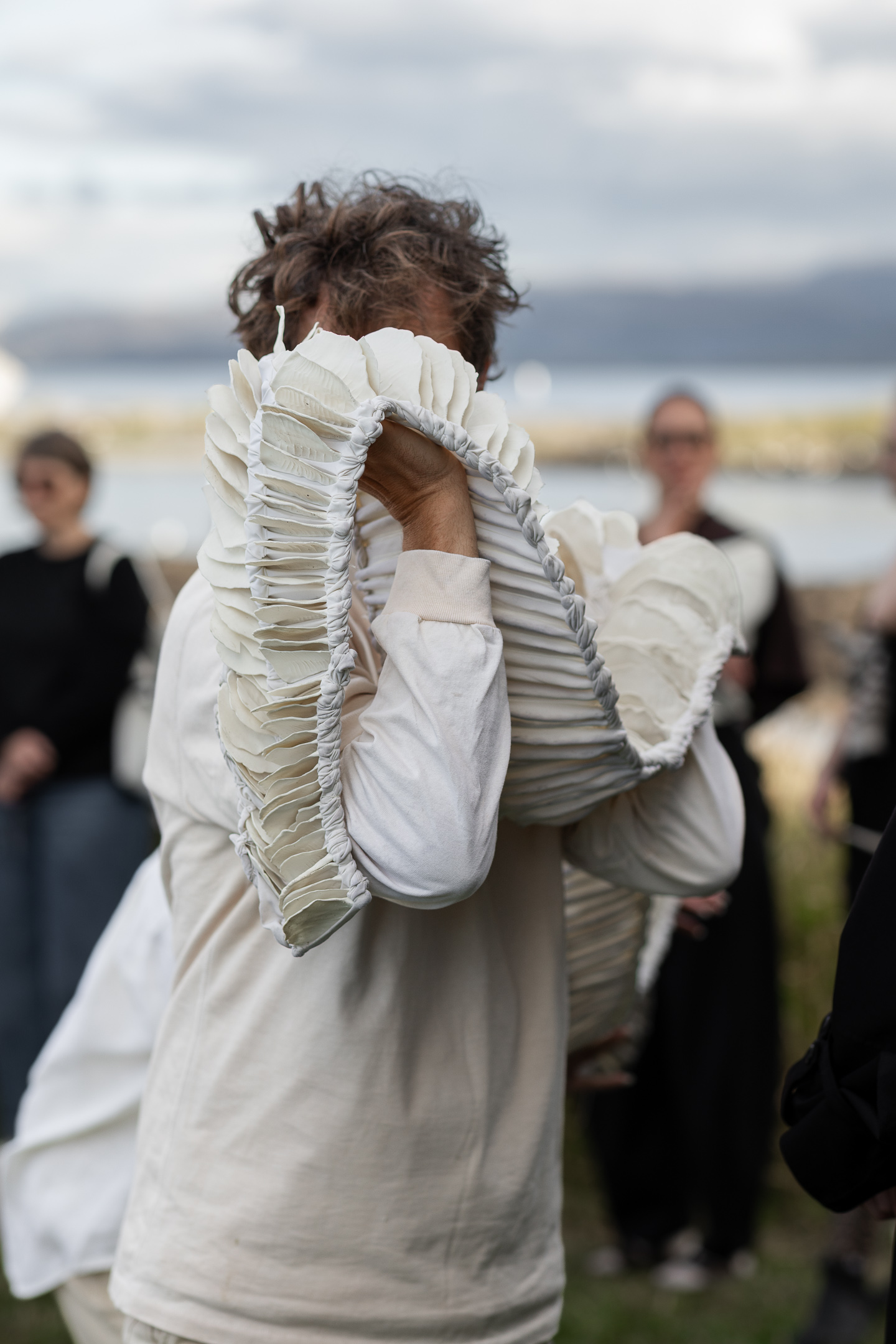
“My body reacted to her static sculpture as if I was seeing a great dancer’s movement.”
Yohei Hamada.
I wanted to introduce their sound, as well as their movements, Hamada says. Together, the artists explored how movement, sound and sculpture could interact. Over time, they discovered similarities between the sculptures and the human body.
By working collectively with the sculptures over the years, Hamada discovered a fragile-but-resilient quality, which is pretty much similar to our bodies.
Shaped by places in the North
While the first artistic research period took place in Bergen, the project continued to develop through work in Northern Norway and Northern Finland. Janita Rantanen says the team intentionally worked in the home regions of the participants, allowing local knowledge and experiences to shape the project.
“Every location, surface, and shift in weather, along with every story and local encounter, has taught us and helped evolve both the piece and our movement as performers.”
Janita Rantanen.
From Daniela’s studio and the urban environment of Bergen in August, the darkness and snow of Uløya in November, the mosquitoes of Inari and the wind of Kiberg in June, the light rain of Harstad, and the rocks, airplanes, and unexpected warmth of Bodø, all of these are visible, audible, and resonate within us and in the sculptures, Rantanen says.
For Hamada, the residency on Uløya allowed the project to fully tune into the north, but each location left traces in both the performance and the creative process.
— Landscapes are important. But for me, the question is if we can get access to “currentscape”, the dynamics of nature and culture on the landscape. As the working locations were connected to each artist's home or sense of belonging, these places naturally led to the concept of "co-existence" and "co-presence" in the project, Hamada explains.
Physical elements from the different locations also became part of the performance, including a reindeer hide from Inari and a shell sound object from Kiberg.
Cross-border collaboration
— From my home in Inari, it's much shorter to Kiberg, Harstad or Uløya than it is to Helsinki, Rantanen points out.
Anima Choir brought together artists from Northern Norway, Sápmi and Northern Finland. For Rantanen, such cooperation is not only valuable but essential. People across the North share climate, infrastructure, history and many common experiences. For the sake of security of supply alone, it is extremely important that we have strong cultural and geographical cross-border connections, both between people and between places.
— It's actually easy for us to collaborate because we are culturally close to one another, she explains.
Hamada also emphasises that the project was shaped less by national borders and more by a shared northern context.
“We are delighted that our small contribution has helped make this remarkable performance possible. The Anima Choir project demonstrates the significant results that can emerge when talented people are given the opportunity to realize their vision”.
Margrethe Alnes, Advisor, Norwegian Barents Secretariat
Always evolving with the north
Following its presentation at Bodø Biennale, both artists see the project as more than a finished performance. Rantanen believes one of the project's most important achievements was the development of a shared artistic practice that can continue to evolve in new places.
“Anima Choir is not a finished piece adapted to fit new locations, but rather a collaboratively developed practice that constantly reinvents itself in new settings.”
Janita Rantanen.
For Hamada, one of the most important outcomes of the project has been finding a stronger sense of belonging in the North.
— What is most important for me is the fact that I had been sensing myself grounded in where I am based.
Anima Choir is an interdisciplinary project in which dance artists activate and animate non-human sculptures created by visual artist Daniela Bergschneider. The project brings together artists from Northern Norway and Northern Finland and received NOK 28,200 from the Barents Secretariat through the BarentsKult programme.